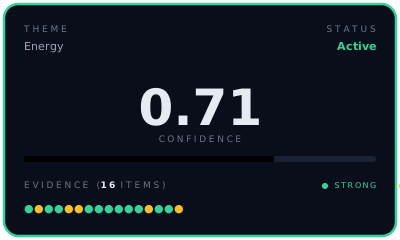
Persistent energy premium
Invalidation
Supporting evidence 16
 Market Data Evidence·Strong
IEA May 2026 Oil Market Report forecasts a 1.78 mb/d 2026 supply deficit (sharp reversal from prior expected surplus), with world supply falling 3.9 mb/d in 2026 and Hormuz-affected Gulf countries 14.4 mb/d below pre-war levels. The market stays severely undersupplied through Q3 2026 even if Middle East fighting ends by early June.
 Analyst Evidence·Moderate
UBS Research expects global oil inventories to approach all-time lows by end-May 2026, corroborating the IEA structural undersupply read.
- Market Data Evidence·Strong
WTI settled near $106 Friday, +4.5% on the day and +11% on the week - the sharpest single-session rate-path repricing of the cycle paired with the structural-undersupply confirmation.
- MetricClose Price
- Value106
 Geopolitical Evidence·Strong
Iran's May 10 demand for full Iranian sovereignty over the Strait of Hormuz remains in force - procedurally incompatible with the durable-reopening leg of the SequencedCondition's invalidation.
 Official Statement Evidence·Moderate
Trump told reporters on Air Force One returning from Beijing he would accept a 20-year suspension of Iranian uranium enrichment with a "real" guarantee - apparent shift from his prior permanent-halt demand and partial convergence toward Iran's floated-15-year framing.
- Official Statement Evidence·Moderate
Trump indicated lifting sanctions on Chinese companies that buy Iranian oil during the Xi summit, signaling a decision is coming - directionally negative for the energy-shock thesis.
- Market Data Evidence·Strong
Exxon Mobil closed Friday May 15 at 157.92, +3.36% on the day in direct repricing of the oil shock.
- SecurityExxon Mobil
- MetricClose Price
- Value157.92
- Market Data Evidence·Strong
Chevron closed Friday May 15 at 191.10, +2.39% on the day - tracking XOM and XLE through the oil-shock repricing.
- SecurityChevron
- MetricClose Price
- Value191.1
- Market Data Evidence·Strong
XLE (Energy Select Sector SPDR) closed Friday May 15 at 59.44, +2.36% on the day.
- SecurityEnergy Select Sector SPDR Fund
- MetricClose Price
- Value59.44
- Geopolitical Evidence·Strong
Iran formally closed the Strait of Hormuz on 2026-03-04, threatening any vessel attempting passage. IRGC issued passage prohibitions, boarded merchant ships, and laid sea mines. Brent surged past $120/bbl on the closure; QatarEnergy declared force majeure on all exports.
- Geopolitical Evidence·Strong
The Honduras-flagged Hui Chuan ("floating armory") was seized off Fujairah on May 15 and diverted toward Iranian waters - subsequently attributed to Iran's IRGC navy by weekend reporting.
- Official Statement Evidence·Strong
Saudi Aramco CEO Amin Nasser stated May 12 that global crude inventory drawdowns have reached 100 million barrels since the Hormuz closure - framing the supply-loss magnitude in operator terms.
- Market Data Evidence·Moderate
Cumulative supply loss from Gulf producers since the Hormuz closure exceeded 1 billion barrels by May 14, per industry aggregation.
- Official Statement Evidence·Strong
China's Foreign Ministry confirmed May 15 that China will continue purchasing Iranian oil - directly cutting against the Thursday Hormuz-open commitment from the Trump-Xi summit.
 Policy Evidence·Strong
Iran's parliament National Security Committee chair Ebrahim Azizi announced Saturday May 16 that Tehran has designed a "professional mechanism" for managing Hormuz shipping movement via the new Persian Gulf Strait Authority (PGSA). Vessels submit ownership, insurance, crew, and cargo forms; tolls (reportedly up to $2M, settled in Chinese yuan) determined by vessel size and cargo; US-linked "Freedom Project" vessels excluded outright. The institutional formalization makes the disruption regime procedurally sustained rather than ad-hoc.
- Geopolitical Evidence·Moderate
Saturday May 16 reporting indicates the Trump administration instructed the UAE to seize Iran's Kharg Island - Iran's primary oil-export hub and one of the operational options the Friday NYT strike-prep piece had listed. Crosses the threshold from "preparations intensifying" to "active asks of regional partners", sustaining the multi-year procurement framing without requiring the kinetic option to actually execute.